Starting with the short film “Amarela,” let’s talk about microaggressions and breaking the silence within the Asian community
Brazil is the second country in the world, after Japan, with the highest concentration of descendants (Nikkei) and Japanese immigrants (as of 2025, there were 2.7 million descendants). Yet, the Japanese-Brazilian community still faces a deep and silent wound: the lack of belonging felt by those born on Brazilian soil who are constantly treated as foreigners and, at times, mistreated.
The short film “Amarela” (Yellow), by André Hayato Saito, made the shortlist for the 2026 Oscars in the “Best Live Action Short Film” category. it invites us to look at this group and reflect on the daily life of being a Japanese-Brazilian person during the 1998 World Cup in São Paulo.
Through the journey of the character Erika (a Japanese-Brazilian teenager living in São Paulo), we are confronted with the weight of microaggressions. These are “subtle” comments, jokes, and “harmless” remarks that attempt to erase the legitimacy and essence of diverse identities.
Phrases like “open your eyes” or “go back to your country” are examples of microaggressions with a clear intent to hurt or exclude. But microaggressions don’t only appear when terms or insults are blatant and direct.
Remarks disguised as compliments, such as “you are exotic” or “you are too beautiful to be Oriental/Asian,” carry a hidden insult, as they imply the person is an exception to their group’s standard. Calling someone “japinha,” “japa,” “china,” or “coréia” is not an affectionate gesture: it is racialization and an invalidation of a person’s identity. In the short film, when Erika’s friend says, “you look cute rooting for Brazil,” it indicates that the friend does not validate Erika—born in Brazil—as truly Brazilian.
Microaggressions and “Recreational Racism“ operate closely together, like a gear of “soft” exclusion. Under the pretext of “it was just a joke,” recreational racism authorizes the reproduction of stereotypes that keep various communities in a state of exclusion. In the book Recreational Racism, written by Adilson Moreira for the Femininos Plurais collection (coordinated by Djamila Ribeiro), he explains that “racist humor is not just a means of spreading stigmas regarding members of racial minorities. Ultimately, its purpose is to affirm the idea that members of the dominant racial group are the only social actors worthy of respect, the only competent social actors.” Humor is frequently used as a tool for maintaining power, where the group’s laughter depends on the silence and humiliation of the minority. In “Amarela,” we see that the price for Erika to participate in the “national celebration of the World Cup final” is tolerating microaggressions and prejudices, including fetishistic remarks. A price far too high for any young person seeking to build their identity and essence with dignity.
Racist humor is, unfortunately, so normalized that in 2025 we saw—live on a major media outlet—an Asian person being targeted by microaggressions, mockery, and jokes, while other white participants were not treated the same way.
Furthermore, we cannot fail to mention the “Model Minority Myth,” a term coined by William Petersen. According to Vivian Hatsumi Makia, there is a common sense in Brazil regarding “yellow” (Asian) people: they are generally seen as intelligent, honorable, hardworking, and efficient, reinforcing a myth that the group achieves success due to their cultural and family values. This myth is harmful and invalidates the Asian experience, as it suggests that social acceptance is conditional upon the pursuit of perfection, maintenance of the status quo, and passivity (not complaining). In the short film, Erika’s silence is not a choice; it is the consequence of living in a context that applauds her as a “model” only to better camouflage the fact that they hardly see her as truly Brazilian.
Recognizing microaggressions and deconstructing the model minority myth is not just a debate about identity; it is indispensable for anyone who wishes to live with authenticity. Breaking the silence is an act of reclaiming the existence of pluralities. It is stating that our belonging is not a favor granted, but a right to exercise our identity.
I invite you to look at your own spaces: where is silence being mistaken for consent? How can we create environments that are more receptive and non-exclusive? The first step to transforming Latin America is ensuring that each of us can occupy our place without needing to camouflage our essence.
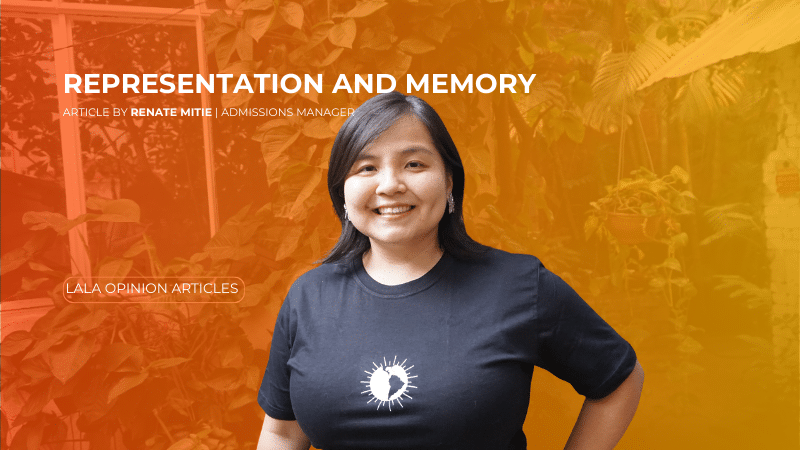
Article by Renate Mitie Fukunaga – Admissions Manager at LALA Brasil