What Comes After Telling Girls They Can
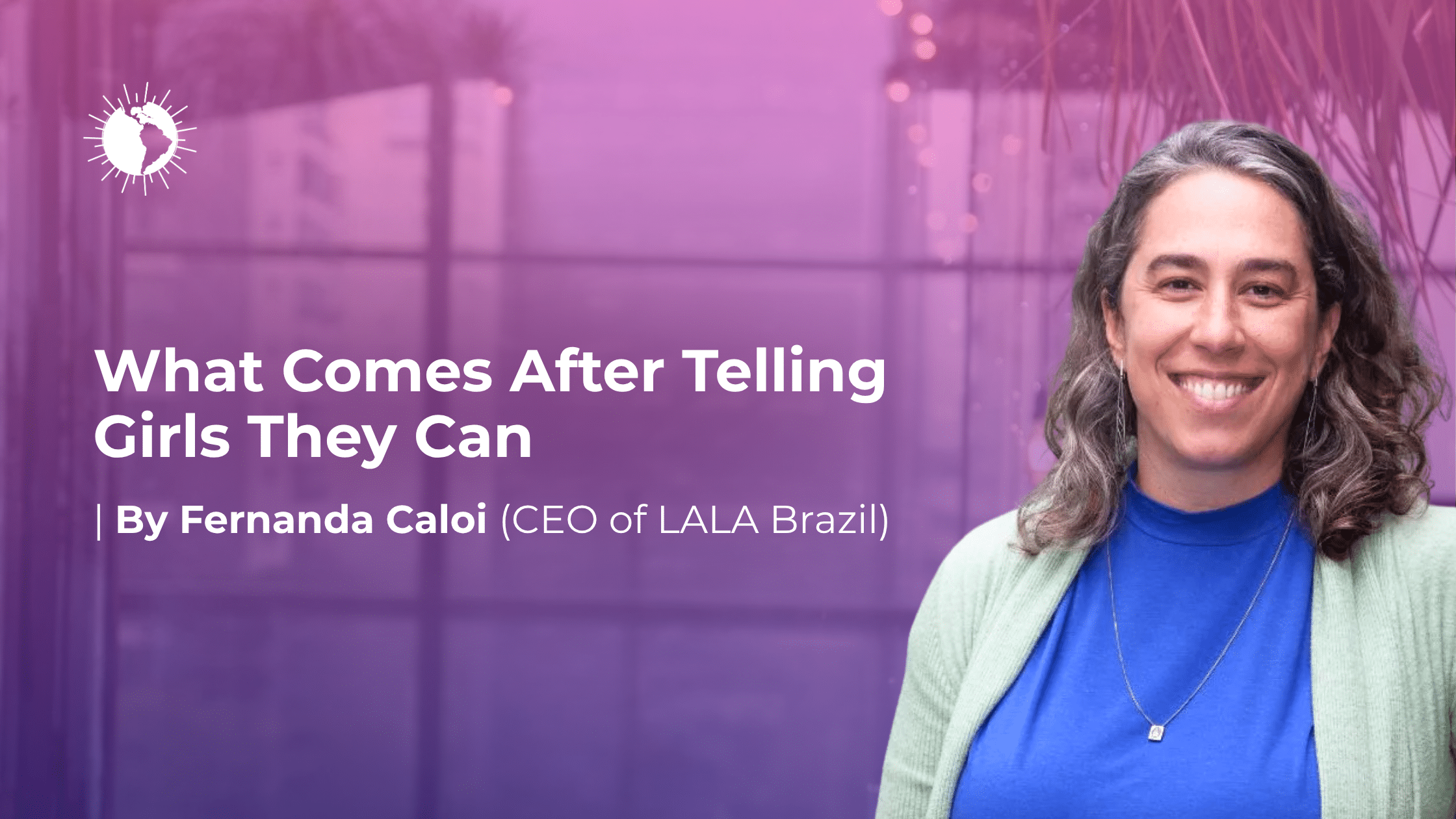
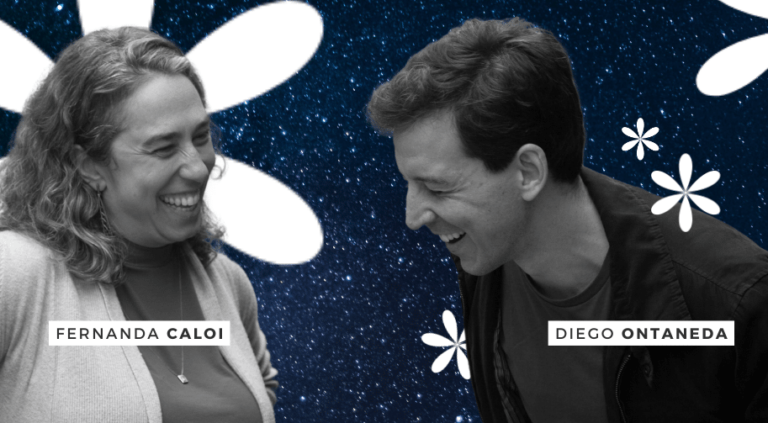
By Fernanda Caloi, CEO of LALA Brazil*
For a long time, talking about female empowerment meant telling girls that they could be whatever they wanted to be. The message was important in broadening their horizons and challenging roles that seemed to have been predetermined. But when we look at the inequalities that still shape women’s professional lives, it is becoming increasingly clear that inspiration alone does not solve the problem. The conversation needs to move toward the concrete conditions that make it possible to turn ambition into a career path, with access to opportunities, networks, resources, and environments that foster development.
Part of this process begins long before entering the workforce. Boys and girls are still exposed to different expectations about what they can be good at, the spaces they should occupy, and the activities they should pursue. We do not need to turn every childhood toy or choice into a discussion about gender to recognize that role models and references also shape what people see as possible. In 2026, UNESCO once again drew attention to the impact of gender stereotypes on girls’ educational choices. According to the organization, women account for only 35% of graduates in science, technology, engineering, and mathematics worldwide, while stereotypes, lack of opportunities, and the absence of female role models continue to be among the barriers to their participation in these fields.
The challenge is that these differences do not disappear when women enter the workforce. Brazil ended 2025 with positive overall employment indicators, including the lowest annual unemployment rate in the historical series of the Continuous National Household Sample Survey (PNAD Contínua). Still, when the figures are broken down by gender, inequality remains. In the fourth quarter of 2025, the unemployment rate among women was 6.2%, compared with 4.2% among men, according to the IBGE’s Quarterly PNAD Contínua. The gap helps explain why increasing individual encouragement is not enough. Women can be more qualified, confident, and prepared and still participate in a labor market that continues to produce different outcomes for men and women.
Compensation reveals another layer of this issue. The 5th Report on Pay Transparency and Remuneration Criteria, released by Brazil’s Ministries of Women and Labor and Employment in April 2026, analyzed information from 53,500 Brazilian companies with 100 or more employees and found an average pay gap of 21.3% between women and men among the companies surveyed. This figure does not mean that women and men performing exactly the same job necessarily receive such a salary difference. Rather, it reveals a structural inequality that is also reflected in the distribution of roles, occupations, and hierarchical positions.
I myself took some time to recognize some of these barriers. At the beginning of my career, I did not have a clear awareness of sexism in the professional environments I moved through. I have always been outspoken, outgoing, and confident about making myself heard in groups, even when I was the only woman in the room. For a long time, I saw this simply as a characteristic of my personality. Over time, I realized that this confidence had also been shaped by the environment in which I grew up, the education I received, and the space I was always given to speak, disagree, and trust my own voice. Not every girl starts life with that same foundation.
This realization became stronger when I joined Google and was part of the team that founded Google for Startups in Brazil. By gaining a closer look at the entrepreneurial ecosystem, I began to see issues that had previously been less apparent to me: women founders struggling to access capital, professionals trying to balance motherhood and career growth, and environments in which female representation in positions of power was still the exception. It was during this period that a friend told me something I have never forgotten. Women who reach prominent positions in sectors marked by gender inequality cannot always choose whether or not to represent that issue. In some way, their very presence already communicates something.
This does not mean that every woman is obligated to turn her career into activism or to bear individual responsibility for correcting historical inequalities. It means recognizing that the starting point and the conditions available along the way remain different. The World Bank’s Women, Business and the Law 2026 report assessed 190 economies and concluded that only 4% of women worldwide live in countries that are close to full legal equality when it comes to economic opportunities. The study also shows that there remains a significant gap between having a right guaranteed by law and being able to exercise that right in practice.
That is why I am increasingly resistant to an idea of empowerment based solely on asking girls to be more confident, resilient, or ambitious. These qualities can help them, but they cannot replace access to opportunities, education, mentorship, professional networks, investment, care infrastructure, and environments where they can develop without constantly having to prove that they deserve to be there. When we treat inequality as exclusively a matter of individual confidence, we risk placing on women themselves the responsibility for overcoming obstacles they did not create.
There has been enormous progress, and it is important to acknowledge it. Today, many more women occupy spaces that for decades were almost exclusively reserved for men. But representation does not necessarily mean equality. The next step in this conversation is to replace part of the discourse around inspiration with a more concrete agenda focused on access. Continuing to tell girls that they can go wherever they want matters, but it is equally necessary to build the conditions that ensure their path does not depend on them always being extraordinary to achieve what, for so many men, still seems simply natural.
* Fernanda Caloi is the CEO of the Latin American Leadership Academy (LALA) in Brazil. With a career dedicated to building communities and developing leaders, she works to educate and empower young Latin Americans with the potential to create social impact in their communities. Throughout her career, she has led initiatives focused on strengthening entrepreneurship and innovation ecosystems, including programs for startups and impact-driven businesses, always with an emphasis on building collaborative networks and expanding opportunities for the continent’s next generation of leaders.
Agência PUB – LALA
Camila Cechinel – (11) 98471-2892 – camila.cechinel@agencia.pub
Júlia Dal Rovere – (11) 97648-3830 – julia.peres@agencia.pub
Anne Fadul – (11) 99335-4527 – anne.fadul@agencia.pub