What accessibility taught me about innovation (and why you benefit from it too)
Whenever I start talking about technology, I like to provoke a reflection: have you ever stopped to think about where the tools you use every day came from?
Often, we look at email, voice commands on our phones, or even that ergonomic vegetable peeler in the kitchen and think they were created solely for modern convenience. But the truth runs deeper. These innovations were born within the disability community. Email, for example, was driven by the need for written communication for those who couldn’t use the telephone; voice commands were the bridge to independence for those who couldn’t type.
What started as a specific solution to a barrier scaled up and transformed the lives of absolutely everyone.
I firmly believe that when we design with accessibility in mind, we solve problems we didn’t even know existed. It’s what we call the “curb-cut effect”: that ramp on the sidewalk, made for wheelchair users, is the same one that makes life easier for a mother with a stroller, an elderly person with reduced mobility, and someone carrying a heavy suitcase. An accessible bathroom, wide enough for a wheelchair, is the same one that welcomes an obese person or someone caring for a small child with dignity.
And do you want an even simpler, everyday example? The use of colors in the office.
I always say: let’s swap the red marker on the whiteboard for darker colors like black, brown, or purple. For a person who is nearsighted or has low vision, the contrast of black on white is the difference between being able to participate in the meeting or being left out. But here’s something curious: this choice also makes life easier for the cleaning crew. Anyone who has ever tried to erase a whiteboard knows that red ink stains the most and is the hardest to remove.
By choosing black for contrast (accessibility), we gain efficiency in space maintenance (practicality).
Ultimately, technology and inclusive design go hand in hand because accessibility isn’t about “helping a minority.” It’s about intelligence. It’s about understanding that by removing a barrier for one person, we end up improving the experience for the entire collective.
But here is an important point: I know it is impossible to be 100% accessible or inclusive all the time. Every need is unique and, sometimes, what helps one person can be a barrier for another. A classic example is the use of terms like “tod@s” or “todXs” to neutralize gender (in Portuguese). While the intention is to include, in practice, those who use screen readers or have cognitive disabilities often cannot understand the message. The software reads it as noise, the mind gets stuck on the “X,” and the communication is lost.
That’s why I want to invite you to take that weight off your daily life. We don’t need to carry the pressure of being “perfect.” That is a bar too high for anyone to reach. What we need is to understand what we can do to include as many people as possible today, knowing that just as technology evolves, people’s needs also change every day.
Accessibility is not a finish line where we receive a “perfection” trophy. It is a journey of continuous learning. It is about intelligence and applied empathy.
When I write or design a project, I don’t seek the flawless. I seek the bridge. What about you? Have you ever stopped to think about how small adjustments can open doors for so many more people?
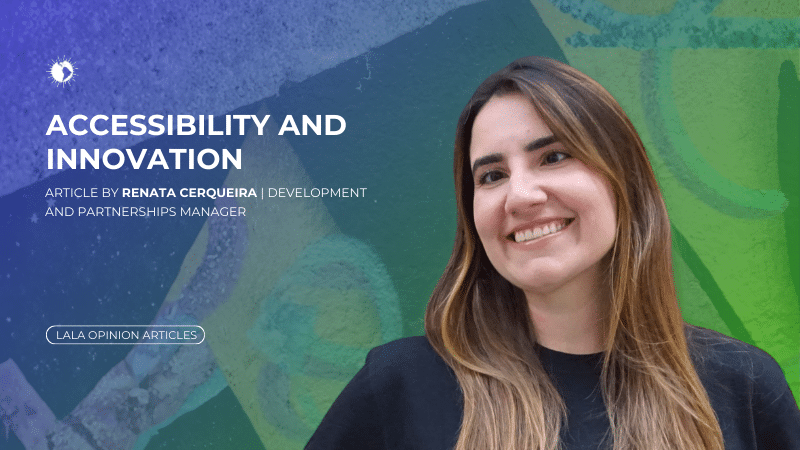
Article by Renata Cerqueira – Development and Partnerships Manager at LALA Brasil